
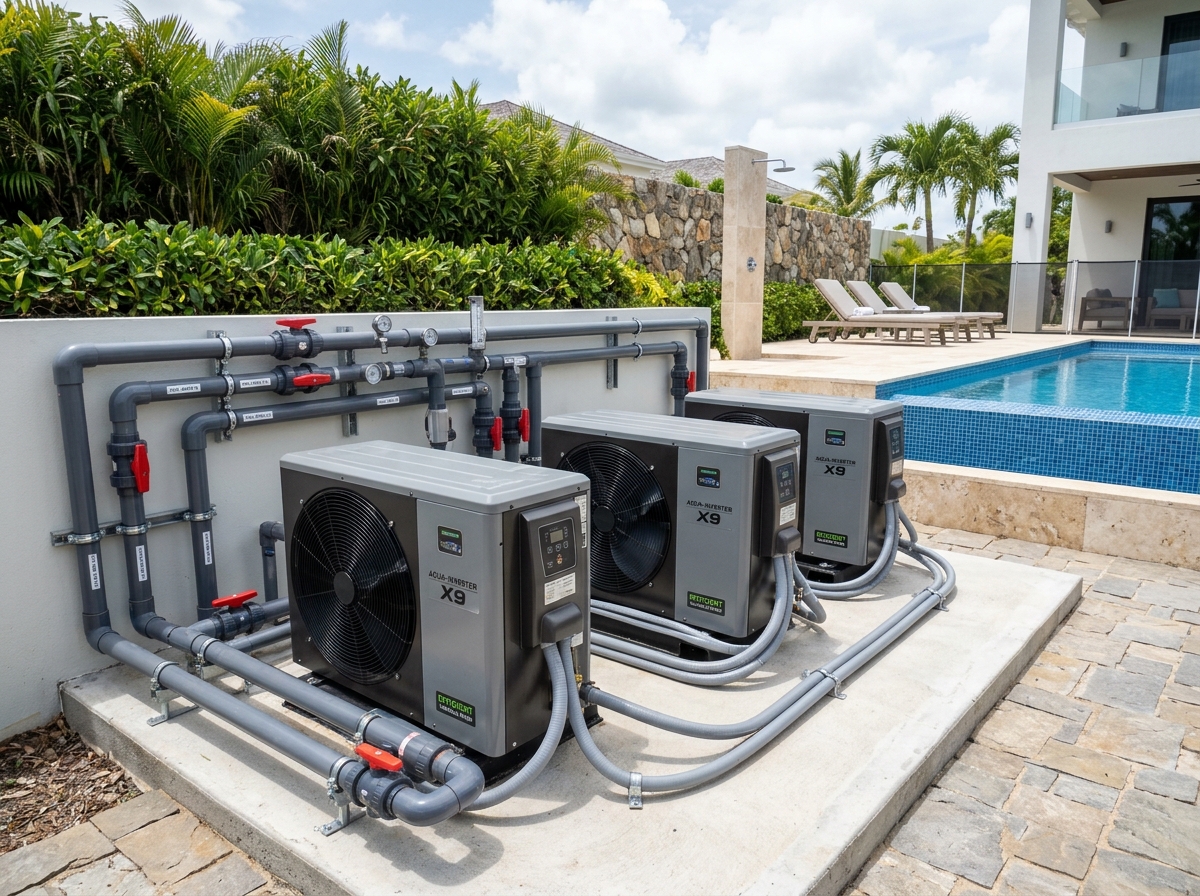
- Inverter Heat Pumps harvest ambient warmth to deliver unmatched daily operating savings and longevity.
- Gas heaters achieve faster rapid warm-up for intermittent use but carry higher utility and service costs.
- Mineral scaling inside heat exchangers cripples thermal transfer and drives energy bills up.
Many villa and club owners ask before winter: should we install a Heat Pump or a Gas Heater? The smart answer depends not solely on how fast the water warms up, but on monthly utility cost, usage frequency, and long-term reliability.
01.01. Inverter Heat Pump Technology
A Heat Pump extracts ambient thermal energy from the surrounding air and transfers it into pool water via a titanium heat exchanger—rather than burning fuel directly. Key advantages:
- Ultra-low electrical draw with high COP thermal multiplication.
- Lowest long-term operating cost for regular residential swimming.
- Longer operational lifespan without combustion wear.
- Tailor-made for continuous seasonal and winter enjoyment.
- Maximum safety with zero open flames or fuel storage hazards.
Considerations: Requires longer initial ramp-up hours on day one and draws efficiency from outdoor air temperature (though advanced Microwell Inverter units excel well into chilly evenings).
02.02. Gas Pool Heaters
Combusts natural gas or LPG to deliver intense direct thermal transfer to passing water.
- Very rapid heat-up capability within hours.
- Practical for huge commercial pools or occasional weekend-only use.
- Heat output remains independent of cold ambient air.
Gas Trade-offs: High fuel consumption, steep monthly utility bills, dependence on steady gas line pressure, and heavier burner maintenance.
03.Direct Comparison: Heat Pump vs. Gas Heater
| Criteria | Heat Pump | Gas Heater |
|---|---|---|
| Heat-Up Speed | Steady & gradual | Very fast |
| Operating Cost | Low / highly economical | High recurring gas bill |
| Safety Profile | Maximum electrical safety | Requires gas venting care |
| Service Lifespan | Longer (10–15 yrs) | Shorter under heavy duty |
04.Best Choice for Villas & How Lime Scale Impacts Heaters
For regular villa swimming with minimal energy expense, an Inverter Heat Pump wins decisively. Gas remains viable strictly for sporadic holiday properties needing sudden overnight heating.
Important Warning: Mineral lime scale dramatically degrades heat exchangers, forcing units to run longer and draw excessive power. Pair heating units with electronic descaling protection.
Top recommended applications for Heat Pumps:
- Private residential villas swimming regularly across cool months.
- Boutique hotels and resorts keeping pools warm continuously.
- Indoor covered pools pairing heating with dehumidification.
- Long-horizon projects prioritizing quiet efficiency and low bills.
Engineering Conclusion
Smart heating investments consider 5–10 year operating bills rather than purchase price alone. My Pools strongly recommends Inverter Heat Pumps for nearly all modern Egyptian villas.
Want Warm Winter Swimming With Minimal Energy Bills?
Get an exact kW thermal load calculation for a European Microwell Inverter Heat Pump tailored to your pool.